Mark Eager
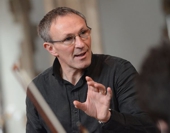
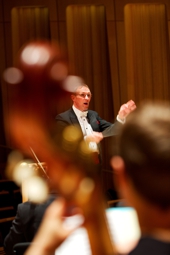
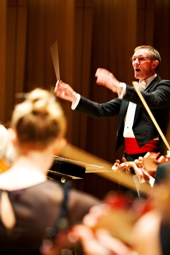
Mark Eager is a highly experienced and exciting conductor with a wealth
of knowledge in the orchestral field, having worked full time with the
BBC National Orchestra Wales for 14 years
click for more....

Mark Eager is a highly experienced and exciting conductor with a wealth
of knowledge in the orchestral field, having worked full time with the
BBC National Orchestra Wales for 14 years
click for more....
“Eager held the orchestra with poise and elegance” – Western Mail
NEWS REEL
REVIEW: Welsh Sinfonia The Welsh Sinfonia delivered another colourful string programme under the direction of Mark Eager at the Dora Stoutzker Hall, featuring the little known Serenade in E flat, Op 6 composed by Josef Suk, alongside other influential composers; William Mathias and Antonín Dvořák. Josef Suk is arguably better known through his compositional studies with Dvořák and the later marriage of Dvořák’s eldest daughter. Suk’s Serenade in E flat was composed at the tender age of 18 and, like the rest of works in this programme, is full of rhythmic vitality mirrored with pure serenity. The strings captured the richness and sublimity of the third movement, which was followed by the distinctively challenging virtuosic finale, which fully demonstrated the technical capabilities of the Welsh Sinfonia. Particular highlights within the work include the numerous violin solos, performed by the leader, Robin Stowell, and also the cello solo in the third movement, performed by Nick Gethin, whose passionate sound could be heard by all. William Mathias’ Divertimento, Op 7 was an excellent choice of repertoire, placed in the thick of Czech compositions, and was most exciting. The rhythmical aspects of the work as a whole were well controlled, culminating with a further rhythmic onslaught in the final movement. The concert concluded with Dvořák’s Serenade for Strings, Opus 22. Perhaps the most popular of the programme, it once again demonstrated the diverse capabilities of this orchestra, who handled all technical aspects of the work with great musicality. The lyrical beauty of the fourth movement was achieved through the tender treatment of the melodic line, which is strikingly different to the finale, which was full of exuberance, excitement, and was a real joy to watch. The Welsh Sinfonia return to the Dora Stoutzker Hall for the final time this season on 22nd March with an orchestral programme of Haydn, Schubert, and features a new commission by John Hardy. by Stephanie Richards |
REVIEW: Welsh Sinfonia at the Dora Stoutzker
Hall, RWCMD The Welsh Sinfonia performed a beautiful selection of works for this short ‘Classical Hour’ concert in the new Dora Stoutzker Hall. Led by Mark Eager, the chamber orchestra performed three classic yet rarely heard pieces, which included William Boyce’s Symphony No. 8 in D minor, Benjamin Britten’s Simple Symphony Op. 4, and Piotr Tchaikovsky’s impassioned Serenade in C for Strings Op. 48. Boyce’s Symphony is a stunning yet little known representation of the music of the eighteenth century. The orchestra chose to perform the work honouring many of the Baroque’s original stylistic features, which was most apparent through the smoother tone gained by using period bowing techniques. It was also refreshing to be able to hear the harpsichord, played superbly by Carl Grainger: one of the benefits of performing in a purpose built concert hall for chamber music. The stately Pomposo (Allegro) moves elegantly through low, sumptuous tones to bright airy passages, contrasting wonderfully with the slower and more refined second movement, Largo (Andante). Finally, the Tempo di Gavotta (Risoluto) ends the work in a steady and graceful dance, leaving the audience wondering why the works of William Boyce are so underperformed. Britten’s Simple Symphony is certainly not child’s play and it is a credit to Robin Stowell for leading this technically difficult work so well. The four movements threw the audience into the twentieth century and demonstrated the orchestra’s fantastic programming. From ‘Boisterous Bourrée’ to ‘Playful Pizzicato’, and ‘Sentimental Sarabande’ to ‘Frolicsome Finale’, this work almost demands the listener to reminisce their youth, and is quite a spectacle in places. Finally, the Welsh Sinfonia performed Tchaikovsky’s well-loved Serenade for Strings, and was perhaps the most passionately performed work of the evening. The orchestra made clear the composer’s love for this piece and no expense was spared in creating a stunningly professional performance of it. The ensemble began and ended phrases smoothly and subtly, and the final pause of the third movement was, despite its technical difficulty, out of this world. Yet again, the Welsh Sinfonia delivered an exciting programme and performed it with the professionalism and technical ability of any of Britain’s foremost chamber orchestras. Their next concert in January 2012 promises to be just as compelling. Star Rating: 5* by Jessica Ruth Morris |
Hello, I’m back in the UK after once again spending a few months abroad, this time working in Australia and The Middle East. I also managed a wonderful trip to Africa, summiting Mount Kilimanjaro:

Things are in full swing with The Welsh Sinfonia after launching our third Cardiff series on 8th October with a concert of “late great“ Mozart in the fabulous new chamber hall at the Royal Welsh College of Music & Drama. We were delighted to have Colin Lawson “the doyen of period clarinettists ” as our guest soloist playing Mozart’s Clarinet Concerto on the basset-clarinet. A rare treat for all! The concert also featured Adagio and Fugue K.546 and the G minor Symphony No 40. I was delighted with the audience’s response and the orchestra gave a really stylish performance, receiving yet more tremendous reviews:
REVIEW: The Welsh Sinfonia Mozart Gala Concert Walking into the impressive new foyer of the Royal Welsh College of Music and Drama, I felt a little apprehensive about the concert that was about to take place. Not only was it happening in the Dora Stoutzker Hall – the UK’s first and only purpose built chamber recital hall - but The Welsh Sinfonia had the privilege of being the first chamber ensemble to perform there since its grand opening earlier this year. No pressure then. But, like the hall itself, the orchestra (conducted by Mark Eager), looked immaculate as they walked on stage to perform their dark but beautiful programme of Mozart’s late works. As soon as the first chord was played it was clear that they would struggle to find any concert hall better suited to them than this. Their rich string sound filled the space and in turn, the hall made the most of the stark dynamic contrasts in the Adagio and Fugue in C minor (K.546). Their level of musicianship was obvious as they responded quickly to Eager’s commands, and small discrepancies in high tuning were rectified immediately. The Fugue was exciting and well executed, with credit to Robin Stowell for leading the ensemble so clearly in what is a technically difficult work. The highlight of the concert was the renowned period clarinettist Colin Lawson performing the Clarinet Concerto in A (K.622). It was a rare treat to see this performed on its intended instrument - the basset clarinet – and Lawson’s mastery of it is undisputed. In the Adagio, I could not help but grin each time the seldom-heard low notes of this clarinet were played, and it was clear that many members of the audience were moved by this piece. It was a nice touch that before performing the Symphony No. 40 in G minor (K. 550), Eager explained the significance of the work, giving it context. The symphony itself was excellent, and remained at a steady pace throughout. However, special acknowledgement must be given to the woodwind for their accomplished exposed sections in the Minuet and Trio. As the work came to a close, it was clear that for the orchestra there was a deep sense of pride, as if a peak had been reached for The Welsh Sinfonia. For the audience, we had experienced a programme that was short and sweet, by an orchestra that is small but perfectly formed. by Jessica Ruth Morris |
This has been a very exciting time for the Welsh Sinfonia. As well as recently announcing our Patron (The Earl of St Andrews), Welsh conductor Grant Llewellyn has agreed to become our President and to have a truly magnificent hall to play in is a joy.
The next series concert is on Thursday 3rd November, again at the RWCMD hall featuring William Boyce’s 8th Symphony, Britten’s Simple Symphony and Tchaikovsky’s Serenade for Strings.
At the beginning of December The WS will be taking part in THE BIG GIVE – a national fund-raising event where money donated gets doubled plus gift aid from the Government. Please visit www.welshsinfonia.co.uk for all the latest news updates and details of upcoming concerts.
Cardiff University Symphony Orchestra is back
in action too and put on a fantastic performance in Llandaff
Cathedral on Saturday 29th October. Paul Dukas’s rousing
fanfare from La Peri set the tone of the evening and the concert
closed with Saint-Saens Organ Symphony – soloist Robert
Court, in celebration of the Cathedral’s newly refurbished
organ. Check out a clip of the finale on YouTube.
www.youtube.com/watch?v=gJdvJ6bMed4 and www.youtube.com/watch?v=gJdvJ6bMed4
It’s now onto Michael Torke’s Bright Blue Music, Stravinsky’s Symphonies of Wind Instruments and Rimsky-Korsakov’s Golden Cockerel Suite for a concert at the BBC Hoddinott Hall on December 17th.
More news coming very soon.
All the best,
Mark
Hi all, this is just a quick update as I’m off on my Australian tour in a few hours – Melbourne, Tasmania and then some sunshine in Cairns. There will be some uploads of exciting new video and audio material coming very soon: (See Video Player Panel to the right)
Tchaikovsky - 6th Symphony 1st movement with Cardiff University Symphony Orchestra
Takemitsu - Toward the Sea II with Claire Jones Royal Harpist, Catherine Handley Flute and The Welsh Sinfonia
Griffiths - The Emoticons of Time (Percussion Concerto) 3rd movement with Dave Danford and WS
The very famous (King’s Speech music!) Beethoven - 7th Symphony 2nd movement with WS
Holst’s wonderful Intermezzo from Suite No. 1 with Herts Wind Sinfonia
Last but certainly not least a World Premiere recording, not even released yet of Adam Gorb’s Concertino for Saxophone with Time Watson and HWS
Please enjoy and I look forward to seeing you at a concert sometime.
Regards to all,
Mark
Watch this space for further news on a monthly basis or please email me:
To see older items now removed from this news reel please click here
intelligently conducted vibrant performance, conceived and executed with an apt sense of scale" musicweb international
"Mark Eager dealt with the piece brilliantly" ..... and is "surely destined for great things" - Western Mail
"stunning and brilliantly realised by Mark
Eager"
The
Guardian
"Mark Eager showed mighty artistry in a delicate
and delectable reading"
South Wales Echo